Monday, November 12, 2018

LAD/Blog #15: Lincoln's First Inaugural Address

Summary:

Lincoln begins the address with the great issue of slavery. He states how he does not want to get involved with the states that already have slavery and believes whether a state will be free/slave should be the decision of the state itself. Lincoln strongly believes that this will maintain the balance of power among the federal/state government. He outlines that it is better to follow the ideals contained in the constitution. In addition, he says his main goal is to Preserve the Union. Lincoln believes that a state will not be allowed to secede by itself. The people of America are friends and not enemies.

Similar to the inaugural address,  Jefferson's inaugural address also tried to unify the country with the current major divides.
 

LAD/Blog #14: Calhoun's Speech on the Compromise of 1850

Summary:

Calhoun's speech outlined that there are different views of slavery and this debate could tear America apart. Calhoun goes on and says that the union needs to be preserved, and is curious where this dispute came from. He acknowledges that the north and south have contrasting views over the topic of slavery. Sectionalism was the problem at heart, as while the north advanced, the south suffered, paying for the taxes the mostly helped the north out. Also, the North had the majority in the house, giving the South very little power when it came to legislation. Above all, Calhoun says how tensions were increasing between the northern and Southern states due to the role of slavery. Finally, Calhoun talks about the issue of admitting California, being his duty.

The most recent presidential election, or any presidential election in nature reminds me of this, as people are split who should be president, just like they are split on if slavery is acceptable or not. 

Sunday, November 11, 2018

LAD/Blog #13: Polk's War Message

The war message begins by stating that conflicts between the US and Mexico need to be addressed sooner or later. John Slidell was sent to Mexican territories, to discuss the killing of United States citizen on American land near the Texas boundary. The Mexican government did not like this, and did not listen. Before Slidell met with Mexican officials, the government was overthrown in the Mexican conflict. The leader of this movement was unwilling to negotiate with Slidell. To avoid invasion, Polk ordered US troops near the southern border at Texas/Mexico. The Mexicans attacked the American military, leaving with some US casualties. Mexico did not want peace with America, so war was the only option. Thus, the US had to go to war with Mexico to regain Texas, defending their territory.

This reminds me of the XYZ affair, as in both cases, America failed at effective diplomacy and was forced to go to war.

LAD/Blog #12: Seneca Falls Declaration of Sentiments

List the democratic principles at the start.
They are:


  • Equality
  • Inalienable Rights
  • Consent of the governed

List 5 grievances.


Here are some:


  • He has compelled her to submit to laws, in the formation of which she had no voice.
  • He has taken from her all right in property, even to the wages she earns.
  • He has monopolized nearly all the profitable employments, and from those she is permitted to follow, she receives but a scanty remuneration.
  • He has denied her the facilities for obtaining a thorough education—all colleges being closed against her.
  • He has endeavored, in every way that he could to destroy her confidence in her own powers, to lessen her self-respect, and to make her willing to lead a dependent and abject life

  • Make note of the final resolution.

    They are determined to achieve their goals to whatever necessary extent. 


    The final copy was signed by 68 women and 32 men.  List 5 notable names (men and men) and make note of one woman who did not sign it.

    Some are:

    Frederick Douglass

    Elizabeth Cady Stanton
    S.E. Woodworth
    Lucretia Mott
    Jane C. Hunt

    To my surprise, Susan B. Anthony did not sign the Declaration.


     One of your pictures should be of the statues of attendees on display at the Women's Rights National Historical Park just down the thruway in Seneca Falls, NY


    The moment for civil rights and the movement for women's rights are similar in that both groups strived for equality under the law.


    The Statues of Attendees


    Monday, October 22, 2018

    LAD/Blog #11: Monroe Doctrine

    Summary:

    The Monroe Doctrine is a speech given to congress by James Monroe regarding foreign policy. In the Doctrine, Monroe dictated his attitude towards Europe and South America, with much of it still true today. Monroe stated that imperialism from European powers was no longer acceptable in North/South America. Also, America was not to interfere with European military engagements, except if they had too, whatever suited the interest of America the best. For example, if America was attacked, this act of conflict would force America to defend itself, and declare war on the opposer. This basis for U.S. foreign policy showed the European powers that imperialism in the Western Hemisphere would no longer be acceptable, making America more of a power nation, making statements as such. Overall, the Monroe Doctrine evolved the Proclamation of Neutrality, showcasing the new nations strength, not tolerating further imperialism by foreign powers.


    Image result for Monroe Doctrine
    Political Cartoon of Monroe Doctrine

    Image result for proclamation of neutrality
    This reminds me of the Proclamation of Neutrality, with both statements being issues  of early foreign policy for the young America.

    Monday, October 8, 2018

    LAD/Blog #10: Jefferson's First Inaugural

    Summary:

    In the first paragraph, Jefferson expresses his gratitude to the American people for being elected to be the next president, while also stating that their will be struggles to overcome in the near future. He then goes on to state that he would like American's to put their differences aside and unite in the interests of the nation over self. Under the constitution, Jefferson stresses the liberties once not given under British governance. Next, Jefferson brings attention to the outlook of America, harping on the fact that the government will protect the rights of the people, along with the consent of the governed. Adding on, Jefferson states the freedoms granted under the Constitution, such as freedom of religion and the press, and a well disciplined militia. After that, Jefferson realizes that he will not be a perfect president, as no one can be a perfect president, and asks for forgiveness if and when he messes up. Finally, he sums up the address by saying he is ready to take office, and, "that Infinite Power which rules the destinies of the universe lead our councils to what is best, and give them a favorable issue for your peace and prosperity".

    Image result for jefferson's 1st inaugural address
    The inaugural address

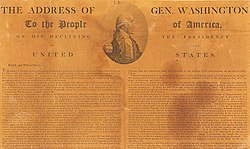
    Image result for george washington farewell address
    This reminds me of Washington's farewell address, as both reference (and warn) the dangers of political parties.

    Blog #9: Was Columbus a hero or villian?

    Image result for christopher columbus
    Christopher Columbus looks scary!


           To a greater extent, Columbus is more a villain than a hero, due to this inhumane, cruel actions to the natives he encountered in his exploration of the new world. Being greedy, he was willing to do anything to achieve his means. This included cutting off the hands of Indian children that failed to collect gold for him. Actions such as this lead the Arawak population in the Bahama's to go as far as committing suicide, as the Indians saw death better than life under Columbus. Columbus also took native prisoners back to Spain, with conditions similar to the Middle Passage, with the Indians dying en route. It is clear that Columbus did not consider the natives he encountered "people", and very inferior, evident by his actions accounted for to this day. Although Indian mistreatment was common by many explorers around this time, it is still unacceptable to dehumanize one just for another's benefit. Thus, Columbus is a villain, who mistreated many during his active years of exploration
    Image result for middle passageThis reminds me of the Middle Passage, as both many Blacks and Indians died of the harsh travel across the Atlantic.